
LEARNING OBJECTIVES
Objectives that are measured, not just listed
Every objective in your course is tagged to Bloom’s taxonomy, mapped to the activities that measure it, and scored on a 0–4 rubric from what your students actually produced. You see mastery per student, and a report for the whole class on any objective in one click.
Your objectives stay in play all the way through the course
Write them once and Learnvelo keeps working with them. Each objective is tagged, mapped to the activities that measure it, and scored from what your students actually produced. So when a chair or a review committee asks whether students met an objective, you have the evidence in hand rather than an inference drawn from letter grades.
0–4
A rubric per objective, five levels, applied consistently across every activity that touches it.
Per student
Mastery is read from the strongest evidence each student produced, not averaged out of quiz scores.
One click
A class report on any objective, scoped to your active enrollment and the window you choose.
HOW IT WORKS
From a line in your syllabus to a score you can defend
STEP 1 · WRITE & TAG
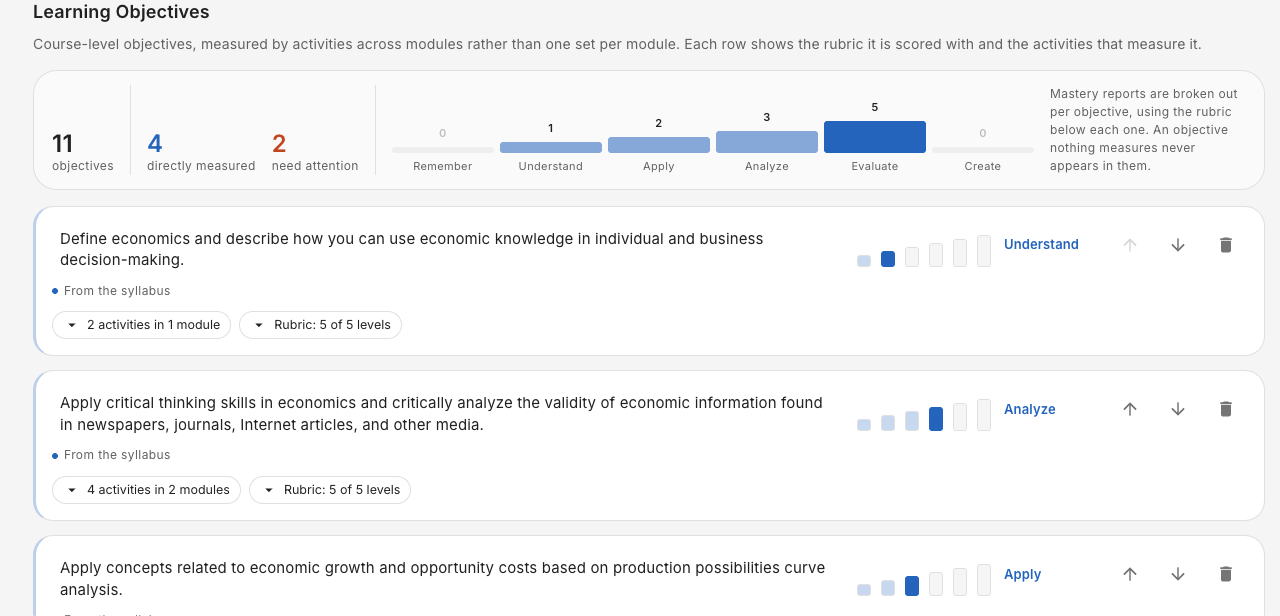
Objectives pulled from your syllabus, tagged to Bloom’s
Upload a syllabus and your objectives come across as written, each one placed at a Bloom’s level. Objectives are course-level rather than one set per module, so a single objective can be built across weeks and measured wherever it appears. Edit the wording or the level at any time.
STEP 2 · MAP TO MEASURES
Every objective shows what measures it — or that nothing does
Each objective lists the activities and questions across your modules that test it. The count is visible on the row, so an objective measured by four activities in two modules looks different at a glance from one measured by nothing. Unmeasured objectives are flagged, and they never appear in a mastery report — a score with no evidence behind it is worse than no score.
11
objectives
4
directly measured
2
need attention
Apply critical thinking skills in economics and critically analyze the validity of economic information found in media.
Evaluate the role of fiscal policy in a recession.
STEP 3 · THE RUBRIC
A 0–4 rubric, written per objective
Each objective carries its own five-level rubric with a descriptor at every level, so “proficient” means something specific to that objective rather than a percentage band. Learnvelo drafts the levels from the objective and its Bloom’s tag; you edit any descriptor, and every activity measuring that objective is scored against the same wording.
| LEVEL | WHAT IT LOOKS LIKE |
|---|---|
| 4 | Advanced. Applies the idea to an unfamiliar case and explains the reasoning. |
| 3 | Proficient. Uses the idea correctly in the situations the course covered. |
| 2 | Developing. Gets there with prompting, or with gaps in the reasoning. |
| 1 | Beginner. Recognizes the idea but cannot yet use it. |
| 0 | No evidence. Nothing the student produced speaks to this objective. |
STEP 4 · STUDENT EVIDENCE
The score points back at the work that earned it
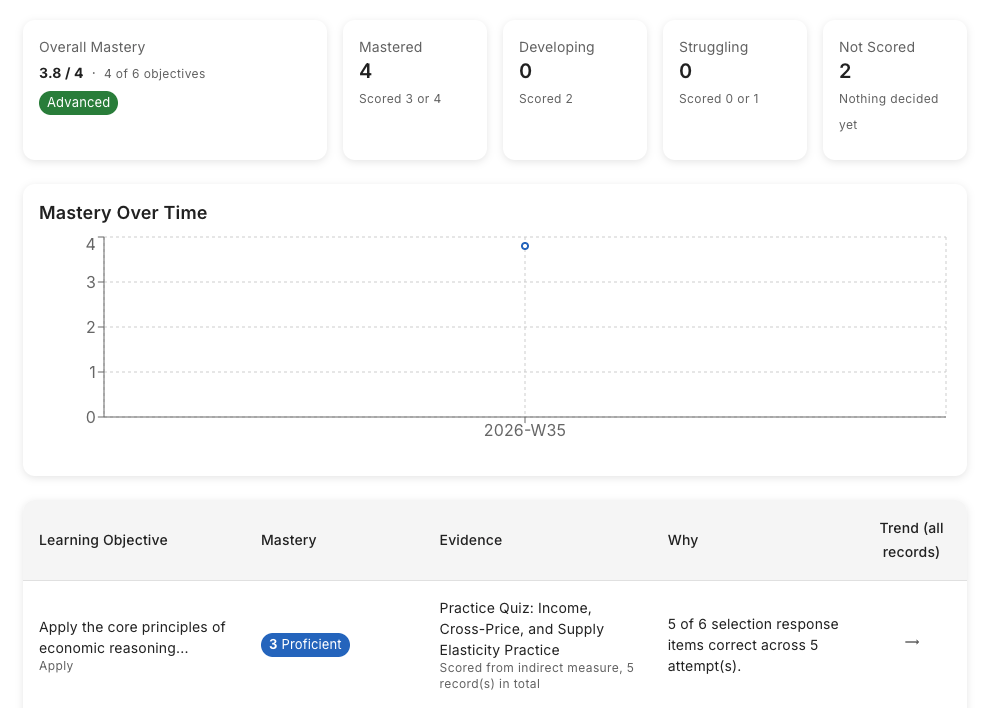
Every interactive activity and question a student completes produces evidence against the objectives it measures. Mastery is a judgment selected from the strongest of that evidence, not an average — and a direct measure, where the student generated something, outranks an indirect one, where they selected from options. You can open any score and see which piece of work decided it.
STEP 5 · MASTERY & REPORTS
See the class, then the student, then the report
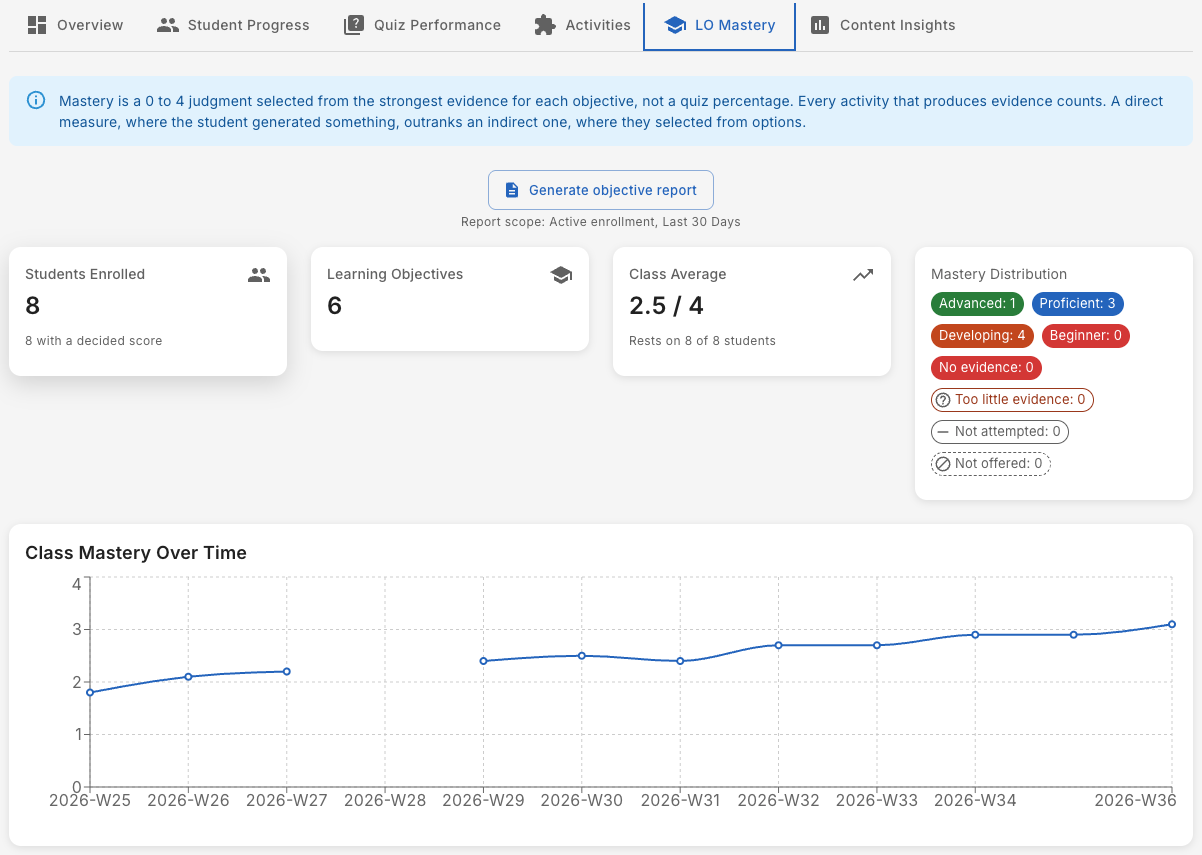
The LO Mastery dashboard gives you class average out of four, the distribution across mastery levels, and how mastery has moved week by week. Drill into a student to see every objective they have evidence for. When you need it on paper, generate a report per objective, scoped to your active enrollment and a date window you set.
It works because the activities are already there
Objective measurement is not a separate thing your students have to do. It reads the seven activity types, the in-browser SQL exercises, the STEM Problem Coach and the Debate Arena that are already part of the course — and graded work still passes back to your LMS gradebook over LTI.
Questions instructors ask
Objectives, rubrics and mappings stay under your control. If something here is not covered, ask us.
Do I have to accept the objectives and rubrics Learnvelo drafts?
No. Objectives, Bloom’s tags and every rubric descriptor are editable, and the mapping between an objective and the activities that measure it is yours to change.
Is mastery the same as a grade?
No. A grade rolls up points; mastery is a 0–4 judgment on one objective, read from the strongest evidence a student produced. They can disagree, and that disagreement is usually the useful part.
What if an objective has almost no evidence behind it?
It is marked as too little evidence rather than given a low score, and the objective is flagged for you so you can add an activity that measures it.
Can I export this for a program review?
Yes. Reports are generated per objective, scoped to active enrollment and a date range, and can be handed on as they are.
See what your objectives are actually measuring
Bring a syllabus and Learnvelo will map its objectives to the activities in your course in minutes.